LightRAG: A Software Engineer's Guide to Faster, Smarter RAG with Knowledge Graphs
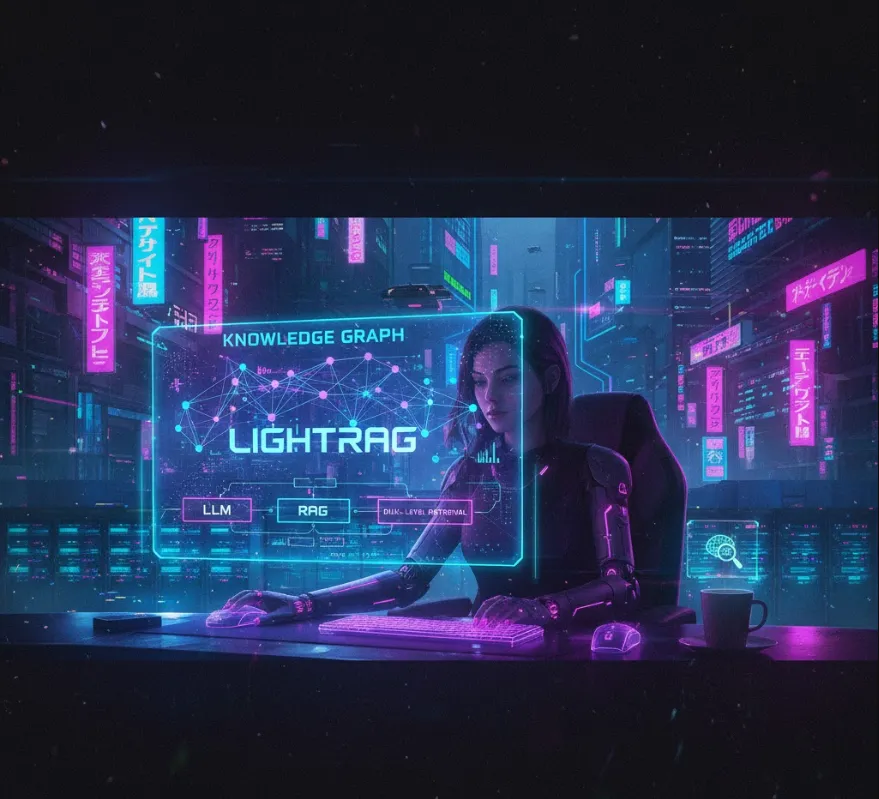
LightRAG is a novel framework for Retrieval-Augmented Generation (RAG) that aims to be simple, fast, and more accurate by leveraging graph structures in the retrieval process. It was presented at EMNLP 2025.
As software engineers, we often build applications that need to provide up-to-date, domain-specific, and coherent answers using Large Language Models (LLMs). RAG systems are essential for this, but traditional RAG sometimes struggles with complex, interconnected information.
LightRAG addresses this by incorporating a Knowledge Graph (KG) into the retrieval step, moving beyond simple flat vector representations.
| Feature | How It Helps Your Application |
| Graph-Enhanced Retrieval | More Coherent Answers: By modeling entities and their relationships as a graph, LightRAG can retrieve interconnected context, leading to LLM responses that capture complex dependencies, not just fragmented pieces of information. This is crucial for domain-specific Q&A on complex documents like legal texts or engineering manuals. |
| Dual-Level Retrieval | Versatile Query Handling: It combines low-level retrieval (for specific entities/relationships) and high-level retrieval (for broader concepts/themes). This means your RAG system can handle both highly specific, factual queries and more abstract, conceptual questions effectively. |
| Simple and Fast (Cost-Effective) | Lower Operational Costs: The paper suggests LightRAG significantly reduces token consumption and API calls compared to prior GraphRAG approaches. This translates directly into lower inference costs and faster response times for your users. |
| Incremental Update Algorithm | Dynamic Adaptability: Unlike some systems that require a full index rebuild when new data arrives, LightRAG's incremental update capability allows you to quickly integrate new information (e.g., new documentation, reports) without excessive downtime or computational cost, keeping your RAG system fresh. |
In short, LightRAG is an engineering solution for building a smarter, faster, and more cost-efficient RAG system for complex data.
Since LightRAG is typically an open-source framework, the core implementation involves setting up the environment, indexing your documents to build the graph, and then running the dual-level retrieval process.
You'll generally need
A powerful LLM
Used primarily for Entity and Relation Extraction during the indexing phase to build the Knowledge Graph from your raw text documents. The authors recommend a strong model (e.g., ≥32B parameters) for this.
An Embedding Model
Essential for calculating vector similarity for both text passages and graph elements.
A Storage Solution
To store the Knowledge Graph (e.g., Neo4j, or a graph database integrated with a vector store like PostgreSQL/pgvector).
Document Chunking
Break your raw documents into smaller passages.
Entity/Relation Extraction
Use the LLM with a specific prompt to extract entities (nodes) and relationships (edges) from each text chunk.
Graph Construction
Store these extracted triples (EntityA,Relation,EntityB) into the graph database, connecting the nodes. The nodes and/or edges are typically linked back to the original text chunks/vectors.
Indexing
The resulting graph and the vector representations of the text chunks form the complete LightRAG index.
# Conceptual Structure - LightRAG Workflow

import lightrag_framework as lr
from lightrag_framework.models import LLM, EmbeddingModel
from lightrag_framework.stores import GraphIndex, VectorStore

# --- 1. Setup ---
# Initialize your models and data store connections
llm_extractor = LLM(model_name="strong-extraction-model")
embedding_model = EmbeddingModel(name="bge-m3")
graph_db = GraphIndex(config={"db_url": "...", "vector_store": VectorStore(...)})

# --- 2. Indexing (Building the Graph) ---
def index_documents(docs_path):
    print("Starting document indexing and graph construction...")
    # Load raw documents
    documents = lr.load_docs(docs_path)

    # The core LightRAG indexing function
    # It performs chunking, LLM extraction, and graph storage
    lr.GraphIndexer(
        documents=documents,
        llm=llm_extractor,
        embedding_model=embedding_model,
        index=graph_db
    ).build_index()
    print("Indexing complete. Knowledge Graph is ready.")

# --- 3. Querying (Dual-Level Retrieval) ---
def query_lightrag(query):
    # The Query Engine uses the dual-level approach internally
    query_engine = lr.LightRAGQueryEngine(
        graph_index=graph_db,
        embedding_model=embedding_model,
        # A separate, potentially stronger LLM for final generation
        generator_llm=LLM(model_name="strong-generation-model")
    )

    print(f"\nProcessing query: '{query}'")

    # Dual-Level Retrieval occurs here:
    # 1. Low-Level: Retrieves specific entities/facts using graph pathfinding/vector search.
    # 2. High-Level: Retrieves broader concepts/themes via vector search on conceptual nodes.
    # The results are combined to form the final context.

    response = query_engine.query(query)

    print("\n--- Answer ---")
    print(response.text)
    print("\n--- Retrieved Context ---")
    # You can inspect the dual-level retrieval sources
    print(response.retrieved_sources)

# Example Usage
# index_documents("./my_company_documentation/")

query_lightrag("What is the dependency of the 'AuthService' on the 'LoggerModule' and why?")