Beyond Neural Networks: Exploring Universal Swarm Engines for System Prediction
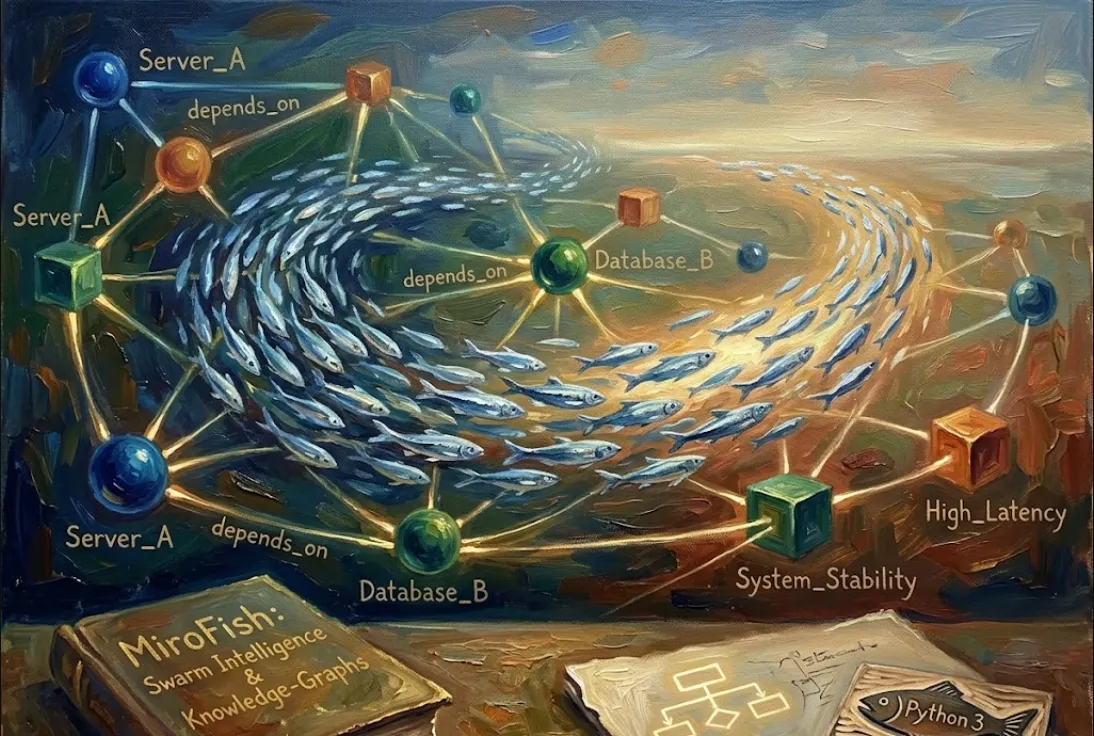
Let's break down MiroFish and see how it can level up your toolkit.
At its core, MiroFish is a lightweight engine designed to harness Swarm Intelligence—the collective behavior of decentralized, self-organized systems. Think of it like a school of fish or a colony of ants working together to find the most efficient path to food.
In the world of software engineering, instead of relying on a single, massive "black box" model, MiroFish uses a "swarm" of simpler agents or data points to identify patterns and predict outcomes.
High Adaptability
Because it uses a "universal" approach, you can apply it to diverse datasets (financial trends, system logs, or user behavior) without rebuilding your logic from scratch.
Knowledge Graph Integration
By combining swarm intelligence with knowledge graphs, it doesn't just look at raw numbers; it understands the relationships between data points.
Efficiency
It’s written in Python 3 and aims for simplicity, making it easier to integrate into microservices or edge computing environments where heavy ML frameworks might be overkill.
Since MiroFish is hosted on GitHub, the standard way to bring it into your environment is via cloning.
First, ensure you have Python 3.x installed. Then, clone the repository and install the requirements
git clone https://github.com/666ghj/MiroFish.git
cd MiroFish
pip install -r requirements.txt
The engine typically functions by initializing a "Swarm" that explores a "Knowledge Space."
While the specific API can evolve, here is a conceptual example of how you might interface with a swarm intelligence engine like MiroFish to predict a simple trend.
from mirofish.engine import SwarmEngine
from mirofish.graph import KnowledgeGraph

# 1. Initialize your Knowledge Graph
kg = KnowledgeGraph()
kg.add_relation("Server_A", "depends_on", "Database_B")
kg.add_relation("Database_B", "status", "High_Latency")

# 2. Setup the Swarm Engine
# We tell the engine to look at the graph and predict the next 'state'
engine = SwarmEngine(graph=kg, agent_count=100)

# 3. Run the prediction
# The 'swarm' explores the connections to find the most likely outcome
prediction = engine.predict(target="System_Stability", steps=5)

print(f"Predicted System State: {prediction}")
The real "magic" here for an engineer is the Knowledge Graph aspect. Traditional regression models often struggle when the context changes. However, because MiroFish looks at the "World" as a graph of connected entities, it can maintain accuracy even when a single node in your system fails or changes.
It’s a great tool if you are building
Self-healing systems
Predicting which service might fail based on swarm consensus.
Complex Recommendation Engines
Moving beyond "people who bought X" to "how does X relate to the user's entire knowledge web."