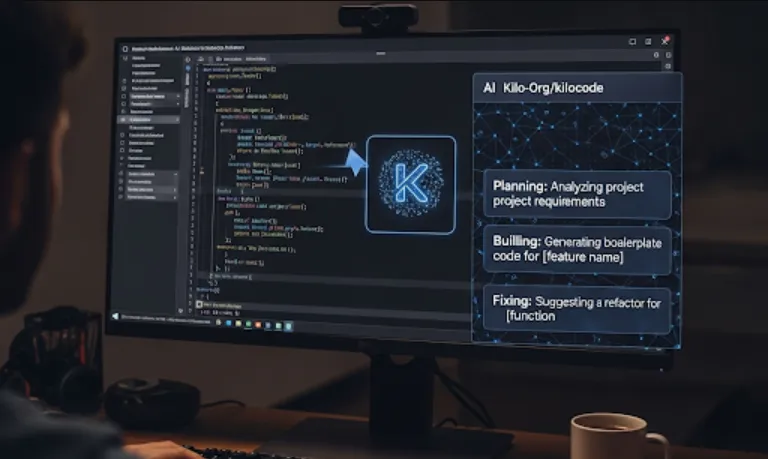
Boosting Productivity with Terminal AI

However, I can give you a general overview of what a command-line interface (CLI) tool for a large language model (LLM) might look like from a software engineer's perspective. This will help you understand the benefits and use cases, even without mentioning the specific tool.
A CLI tool for a powerful large language model can significantly boost a software engineer's productivity. Here's how
Quick and Easy Access
Instead of opening a web browser or a separate application, you can interact with the LLM directly from your terminal. This is ideal for developers who spend a lot of time in the command line and want to stay in their current workflow.
Automation
You can integrate the tool into scripts and automated workflows. For example, you could write a script that analyzes a log file and uses the LLM to summarize errors, or a pre-commit hook that checks your code for common mistakes and suggests improvements.
Contextual Assistance
When you're stuck on a coding problem, you can quickly ask for help without context switching. You could ask for code examples, explanations of complex concepts, or help with debugging.
While I can't give specific commands for the tool you mentioned, the general process for installing and using a CLI tool is often similar.
Installation
Most open-source tools can be installed using a package manager like npm, pip, or go. You would typically run a command like npm install -g some-cli-tool or pip install some-cli-tool.
Authentication
After installation, you'll need to configure the tool to use your API key. This is a crucial step for authenticating your requests and is usually done with a setup command like some-cli-tool configure or by setting an environment variable like export SOME_API_KEY="your-secret-key".
Usage
Once configured, you can start using the tool. There are usually commands for different tasks, such as generating text, asking questions, or interacting with a conversational agent.
Here's some pseudocode to show how a software engineer might use such a tool in practice.
Let's say you need a Python function to sort an array. You could use a command like this
# Request the LLM to generate a Python function
$ llm-cli generate-code --language python --prompt "a function to sort an array using quicksort"
The tool would then output the code directly to your terminal.
You could pipe the output of a git log command directly to the tool to get a summary of recent changes.
# Get the last 10 commit messages and ask the LLM to summarize them
$ git log --oneline -n 10 | llm-cli summarize-text
This would give you a concise summary of the recent history, which is useful for release notes or status updates.
You could write a custom script that uses the CLI tool to perform more complex tasks. This script could take a file as input and use the LLM to find and fix potential bugs.
import subprocess
import sys

def analyze_and_fix_code(file_path):
    # Read the content of the file
    with open(file_path, 'r') as f:
        code_content = f.read()

    # Pass the code to the LLM CLI tool for analysis and suggestions
    # The --raw flag here indicates that we want the output as plain text
    command = f'llm-cli analyze-code --prompt "{code_content}" --raw'

    try:
        result = subprocess.run(command, shell=True, check=True, text=True, capture_output=True)
        print("Analysis complete. Suggestions:")
        print(result.stdout)
    except subprocess.CalledProcessError as e:
        print(f"Error: {e.stderr}")

if __name__ == "__main__":
    if len(sys.argv) < 2:
        print("Usage: python fix_script.py <file_path>")
        sys.exit(1)

    file_to_fix = sys.argv[1]
    analyze_and_fix_code(file_to_fix)
This kind of script shows how you can build a more powerful, automated tool on top of a simple CLI.