Beyond Statelessness: Integrating Persistent Memory with Memori for LLM Applications

Here is a friendly, detailed breakdown of how Memori can benefit you, along with guidance on adoption and sample code, all from a software engineer's perspective.
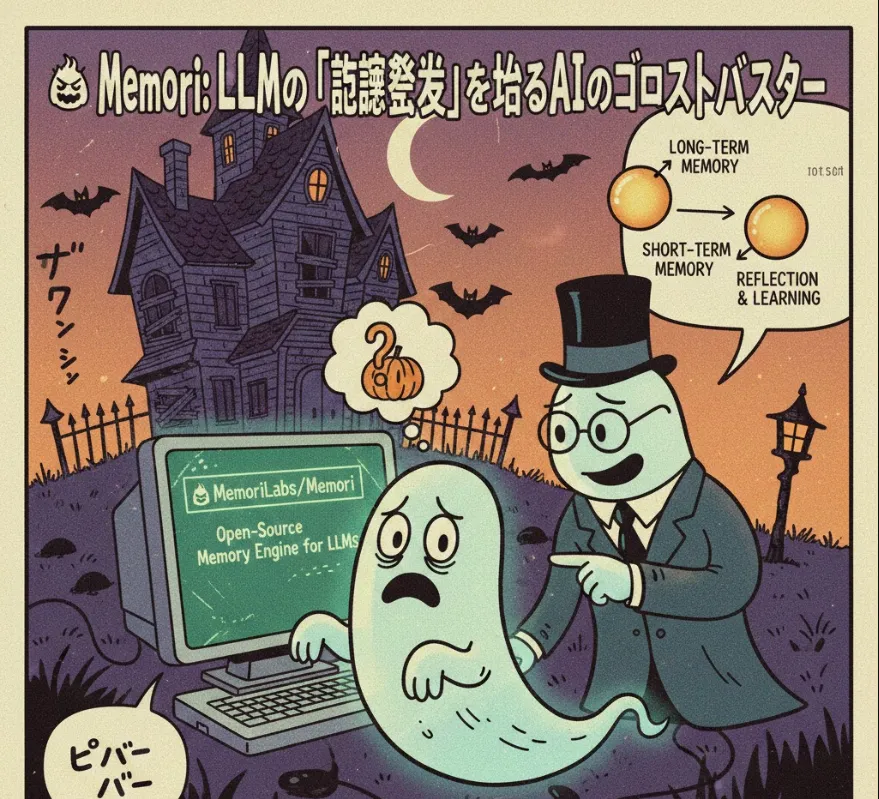
The core challenge when building applications with LLMs is giving them persistent, meaningful context. Without this, an LLM is stateless—it forgets everything after each API call. Memori solves this by acting as a sophisticated, external Memory Engine.
Memori allows your agents to remember past interactions, decisions, and outcomes across multiple sessions. This shifts an LLM from a simple stateless function to a stateful, adaptive agent.
Learning and Adaptation
An agent can remember that a particular approach failed last time and adjust its strategy.
Personalization
It can recall user preferences, context, or project details, leading to more tailored and relevant responses.
For engineers, dealing with context windows (the maximum text an LLM can process at once) is often a headache involving chunking and retrieval-augmented generation (RAG). Memori manages this complexity for you.
Automatic Retrieval
Instead of manually searching a vector store and injecting text, you simply query Memori. It intelligently retrieves the most relevant "memories" and feeds them to the LLM.
Memory Structure
It structures memory beyond simple text embeddings, offering various memory types (e.g., episodic, semantic, declarative) to cater to different retrieval needs.
If you are building an ecosystem where multiple specialized agents cooperate (e.g., a "Planner Agent," a "Coder Agent," and a "Tester Agent"), Memori becomes the shared consciousness.
Agents can store information in Memori for other agents to retrieve, facilitating complex workflows and collaboration without passing massive context strings directly between them.
Memori is a Python-based library, making its integration straightforward for most LLM projects.
You install it like any other Python package using pip.
pip install Memori
Memori is designed to be storage-agnostic. While the documentation will detail all options, you'll typically configure a backend. Common choices include
In-memory
Good for quick testing and ephemeral data.
Vector Database (e.g., Pinecone, ChromaDB)
Essential for production to store and retrieve large volumes of vector embeddings (the core of semantic memory).
SQL/NoSQL Database
For structured memory or metadata.
Let's look at a simplified example of how an agent can use Memori to remember a user's stated preference.
First, you initialize Memori and define a simple agent's "persona" or ID.
from memori import Memori

# Initialize Memori (using a simple in-memory backend for this example)
memory_engine = Memori(storage_backend="in_memory")

# Define the Agent's identity
agent_id = "Project_Manager_Agent_001"

# --- SCENARIO 1: Storing a fact/preference ---
user_input = "The project deadline for the new feature is Friday at 5 PM."
context_metadata = {"source": "user_chat", "importance": 0.9}

# Store this information in the agent's memory
memory_engine.store(
    agent_id=agent_id,
    content=user_input,
    type="declarative", # Storing a simple fact
    metadata=context_metadata
)

print(f"Memory stored for agent: {agent_id}")
Later in the conversation, the agent needs to check if a deadline exists before scheduling a task.
# --- SCENARIO 2: Retrieving a memory ---

retrieval_query = "What is the critical deadline for the new feature?"

# Retrieve the most relevant memories based on the query
# Memori handles the vector search and ranking internally
retrieved_memories = memory_engine.retrieve(
    agent_id=agent_id,
    query=retrieval_query,
    limit=3
)

# You now inject this retrieved context into your LLM call
context_for_llm = "\n".join([mem.content for mem in retrieved_memories])

print("\n--- Retrieved Context for LLM ---")
print(context_for_llm)

# Example of what you'd send to the LLM (e.g., OpenAI API, Anthropic, etc.):
# prompt = f"Based on the following context: '{context_for_llm}', is the agent available to work on a non-critical bug fix on Thursday?"
# LLM will answer "No, the critical deadline is Friday 5 PM."
By using Memori, you decouple the memory management logic from your LLM prompt construction, making your agent code cleaner, more robust, and significantly more intelligent.