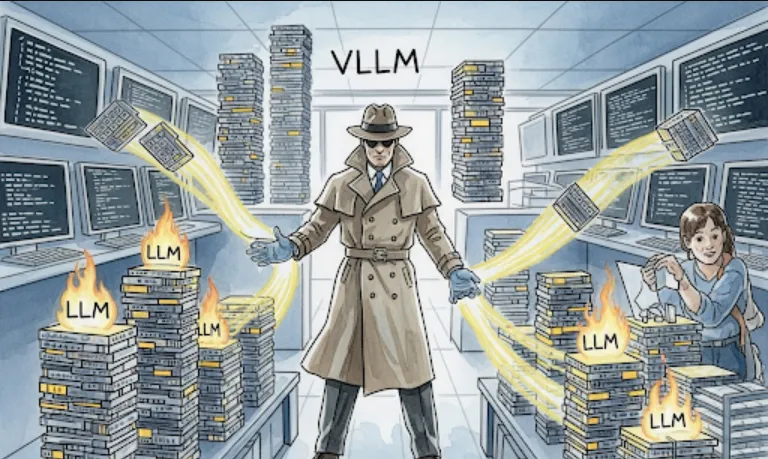
Code Clean and Speed Fast: Understanding LLM Serving with Nano vLLM

Nano vLLM is a lightweight, clean-code implementation of the core ideas behind vLLM, a high-throughput LLM serving engine. It's written in just around 1,200 lines of Python code, making it highly readable and a great educational tool.
It focuses on providing fast offline inference (batch processing of requests) while incorporating key performance optimizations comparable to the original, more complex vLLM.
For a software engineer working with LLMs, Nano vLLM is beneficial in several ways, particularly for projects requiring efficiency, customization, or deep understanding of inference
Understanding Core Optimizations
As a clean and compact codebase, it's an excellent learning resource. It clearly demonstrates how cutting-edge techniques like PagedAttention and Prefix Caching work, which is invaluable for infrastructure or ML engineering roles.
Rapid Prototyping
Its simplicity makes it much easier to test and integrate novel ideas for inference optimizations (e.g., a new scheduling algorithm or caching mechanism) without wading through the complexity of a massive production-grade framework.
Educational Tooling
It serves as a fantastic starting point for building custom LLM serving solutions or for educational purposes, allowing you to quickly isolate and study the performance impact of different components.
Custom Hardware Exploration
The transparent nature of the code makes it easier to map inference optimizations to specialized or emerging AI hardware accelerators.
Despite its minimal size, Nano vLLM implements several advanced optimizations
Prefix Key-Value Caching
Efficiently reuses the key-value (KV) cache for sequences that share the same initial prompt, avoiding redundant computation and saving memory.
Tensor Parallelism
Supports distributing the workload across multiple GPUs (though the minimal implementation defaults to a single GPU setup).
CUDA Graph Capture
Converts the inference path into a persistent GPU execution graph, which significantly reduces CPU-GPU synchronization overhead for faster auto-regressive generation.
PyTorch Compilation (torch.compile)
Utilizes kernel fusion and graph optimization to minimize runtime dispatch overhead.
You can install Nano vLLM directly from its GitHub repository using pip
pip install git+https://github.com/GeeeekExplorer/nano-vllm.git
The API is intentionally designed to mirror vLLM's interface for ease of use. Here's a basic example for running inference
from nanovllm import LLM, SamplingParams
import torch

# Ensure your model path is correct, e.g., downloaded via huggingface-cli
MODEL_PATH = "/YOUR/MODEL/PATH"

# 1. Initialize the LLM engine
# enforce_eager=True is a common setting for initial setup or debugging
llm = LLM(
    MODEL_PATH,
    enforce_eager=True,
    tensor_parallel_size=1
)

# 2. Define sampling parameters
sampling_params = SamplingParams(
    temperature=0.6,
    max_tokens=256,
    top_p=0.9
)

# 3. Prepare your prompts
prompts = [
    "Hello, Nano-vLLM. Can you tell me a short story about a space explorer?",
    "Explain the concept of PagedAttention in one sentence.",
    "Write a Python function for quicksort."
]

# 4. Generate the output
# The generate method is the primary function, similar to vLLM's
outputs = llm.generate(
    prompts=prompts,
    sampling_params=sampling_params
)

# 5. Process and print results
for i, output in enumerate(outputs):
    prompt = output.prompt
    generated_text = output.outputs[0].text # Access the generated text
    print(f"--- Request {i+1} ---")
    print(f"Prompt: {prompt.strip()}")
    print(f"Generated Text: {generated_text.strip()}\n")

# You can also access metrics like total generated tokens, etc., from the output object.
This project simplifies the complex world of high-performance LLM serving, making it accessible and easy to study!