Beyond Vector DBs: Architecting Self-Evolving Agents with OpenViking
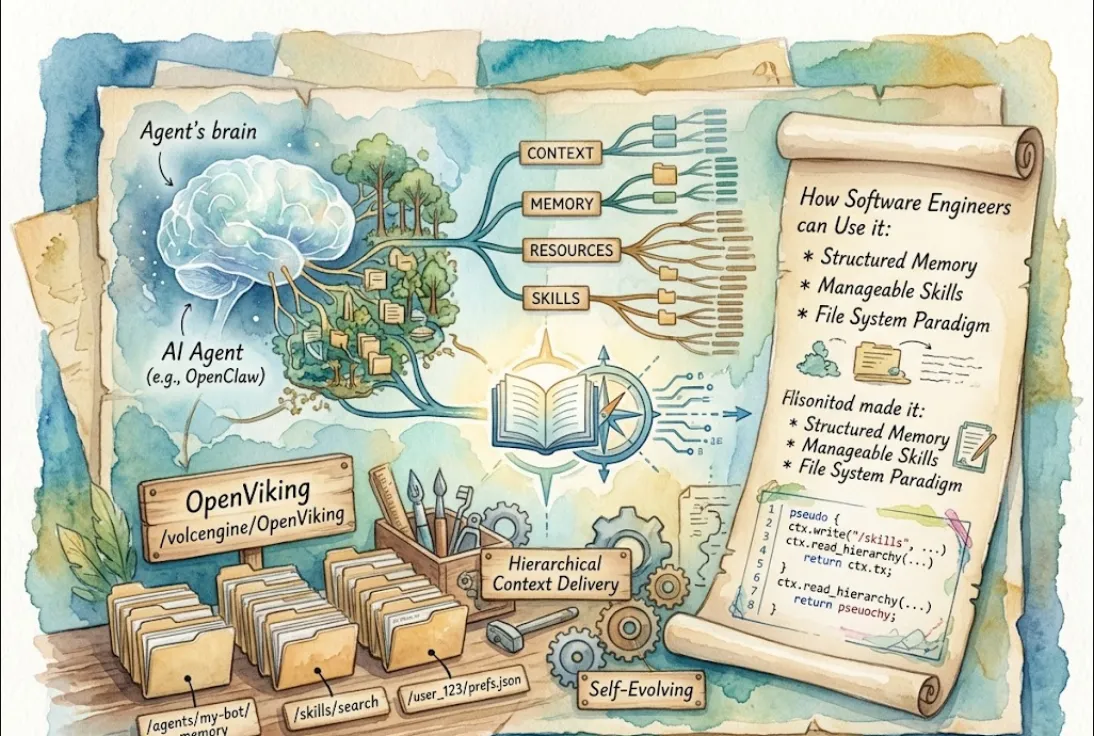
If you’re building AI Agents, you’ve probably realized that "context management" is where things usually get messy. OpenViking is a pretty slick solution because it treats an Agent's brain like a File System.
Here is a breakdown of why this matters and how to get started.
In standard LLM apps, we often just shove everything into a "system prompt" or a flat vector database. OpenViking changes the game by using a hierarchical context delivery system.
Think of it like this
Memory
Instead of just "history," it's structured data your agent can retrieve.
Skills
These are essentially your Agent's "tools" or "executable functions."
File System Paradigm
Just like /home/user/config, you can organize context by scope (global vs. session-specific).
Since OpenViking is designed to be a "Context Database," you typically run it as a service that your Agent interacts with.
Usually, you’ll pull it via Go (since it's part of the Volcengine ecosystem) or run it via Docker.
# Clone the repo
git clone https://github.com/volcengine/OpenViking.git
cd OpenViking
# Follow the build instructions in their README
The VFS (Virtual File System)
Everything is a path. /agents/my-bot/memory
The Loader
How the agent "reads" its skills.
Imagine you want your Agent to remember a user's preference and use a "search" skill. Here is how the logic looks from a developer's perspective
# Note: OpenViking is often used via an API or a Go-based SDK.
# Here is the conceptual flow in Python:

import openviking_client

# 1. Initialize the Context Manager
ctx = openviking_client.connect("localhost:8080")

# 2. Define a "Skill" (Stored as a file/resource)
ctx.write("/skills/weather_check.py", "def get_weather(city): ...")

# 3. Add to "Memory"
ctx.write("/memory/user_123/prefs.json", "{'unit': 'celsius'}")

# 4. Hierarchical Retrieval
# When the Agent starts a session, it "mounts" these paths
session_context = ctx.read_hierarchy([
    "/skills",
    "/memory/user_123"
])

print(f"Agent is now armed with: {session_context}")
One of the coolest claims of OpenViking is that it allows for self-evolution. Because the context is a file system, the Agent can technically write its own skills.
If the Agent realizes it needs a new way to format data, it can write a new script to its own /skills folder, and because the system is hierarchical, that skill becomes immediately available for the next task. It’s like an OS for your AI!
| Feature | Traditional Way | OpenViking Way |
| Organization | Long strings of text | Structured File/Folder paths |
| Memory | Database queries (Vector/SQL) | VFS (Virtual File System) |
| Scalability | Hard to manage "state" | Inherits file system hierarchy |