Model Context Protocol Java SDK: Seamless LLM-Tool Integration for Enterprise Applications
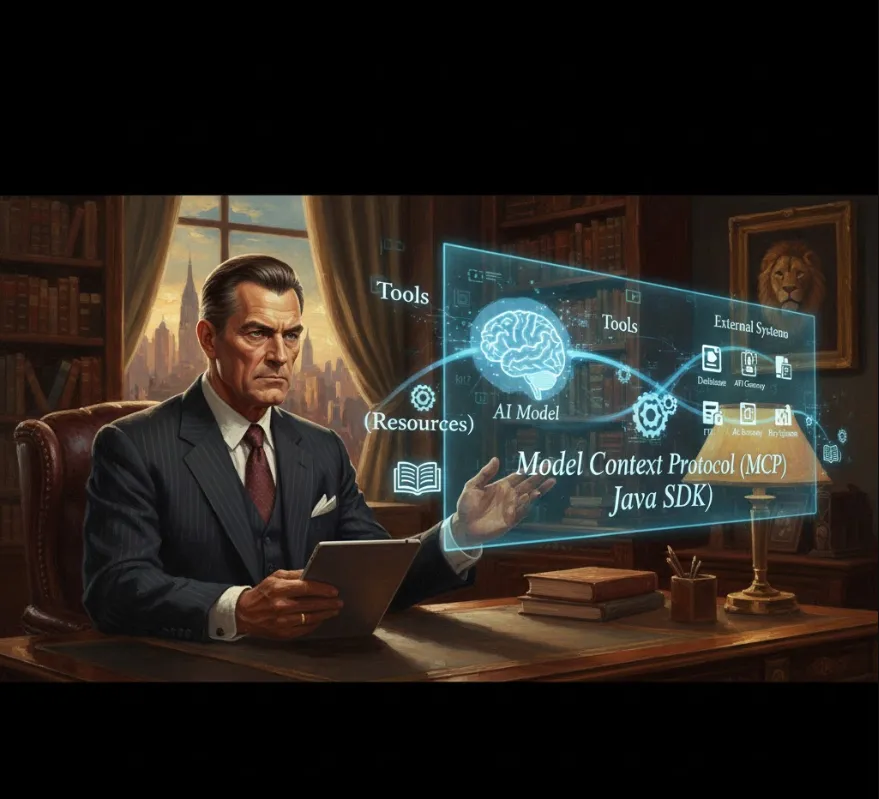
The Model Context Protocol (MCP) is an open standard designed to let AI models, particularly Large Language Models (LLMs), communicate and interact seamlessly with external data sources and tools.
The MCP Java SDK is the official implementation that brings this capability to Java applications. It allows your Java services to act as either an MCP Client (an application that uses an AI model and needs context) or an MCP Server (a service that provides data, tools, or business logic to the AI model).
As a software engineer, this SDK provides a standardized, clean way to enhance your AI applications
The Problem
LLMs are powerful but can't directly interact with your private databases, internal APIs, or perform complex, domain-specific calculations.
The Solution
The SDK allows you to easily expose Java functions or methods as "Tools" that the LLM can discover and invoke. For example, an LLM could decide it needs to "query the customer database" or "calculate a specific discount" and use your Java service to execute that action. This enables tool-use or function calling in a standardized way.
The Problem
AI model conversations often lack real-time or proprietary context, leading to generic or incorrect responses.
The Solution
You can use the SDK to define and manage "Resources" (e.g., specific files, documentation, or URI-addressable data). The AI client can then subscribe to these resources for up-to-date, relevant context, ensuring the model's response is grounded in your application's data.
The Problem
Integrating different AI models or host applications often requires custom, fragmented APIs and communication protocols.
The Solution
Since MCP is an open protocol, the SDK provides a single, consistent interface for communication. Your Java-based data/tools can be used by any AI application (the host) that speaks MCP, regardless of the host's programming language (Python, TypeScript, etc.). This makes your services highly interoperable.
The SDK supports both synchronous and asynchronous communication, handles protocol version negotiation, and offers multiple transport implementations (like STDIO for simple inter-process communication or HTTP/SSE for web-based services). This makes it robust enough for enterprise-level deployments.
If you're using a build system like Maven or Gradle, you'll need to add the SDK dependencies. Since it works closely with Spring AI, let's look at a typical Spring Boot/Spring AI setup (where your Java service acts as an MCP Server to expose tools).
If you're using Spring Boot and want to expose your MCP server over HTTP
Maven Example
<dependency>
    <groupId>io.modelcontextprotocol.sdk</groupId>
    <artifactId>mcp-server</artifactId>
    <version>...</version> </dependency>
<dependency>
    <groupId>io.modelcontextprotocol.sdk</groupId>
    <artifactId>mcp-spring-webflux</artifactId>
    <version>...</version> </dependency>
(You'd also typically have Spring Boot and Spring AI dependencies.)
You define a simple Java method and annotate it to tell the SDK (and, by extension, the AI model) that it's an available "Tool."
Java Example (Tool Definition)
Imagine you have a service that converts units. You want the AI model to be able to call this.
import io.modelcontextprotocol.sdk.server.tool.Tool;
import io.modelcontextprotocol.sdk.server.tool.ToolProperty;
import io.modelcontextprotocol.sdk.server.tool.ToolSpecification;
import org.springframework.stereotype.Service;

@Service
public class UnitConversionService {

    // 1. Define the Tool using the specification annotation
    @ToolSpecification(
        name = "convertUnit",
        description = "Converts a temperature from Celsius to Fahrenheit.",
        // 2. Define the parameters the model needs to provide
        properties = {
            @ToolProperty(name = "celsius", type = "number", description = "The temperature in Celsius to convert.")
        }
    )
    // 3. Implement the Tool's logic
    public Tool convertUnit(double celsius) {
        double fahrenheit = (celsius * 9/5) + 32;
        // The Tool returns a result that the model will use
        return Tool.ofResult(fahrenheit + " F");
    }
}
Your Java service starts up as an MCP Server and registers the convertUnit tool.
An AI Application (MCP Client), perhaps an AI code assistant running in an IDE, connects to your server.
The client's AI model asks, "What is 20 degrees Celsius in Fahrenheit?"
The AI model sees the convertUnit tool available via the MCP, recognizes it can solve the request, and generates a tool call with the argument celsius: 20.
Your MCP Server (the Java app) receives the tool call, executes the convertUnit(20) method, which returns 68.0 F.
The result is sent back to the AI model, which then generates the final, accurate answer
"20 degrees Celsius is 68.0 degrees Fahrenheit."