How BitNet Makes LLMs Smaller and Faster
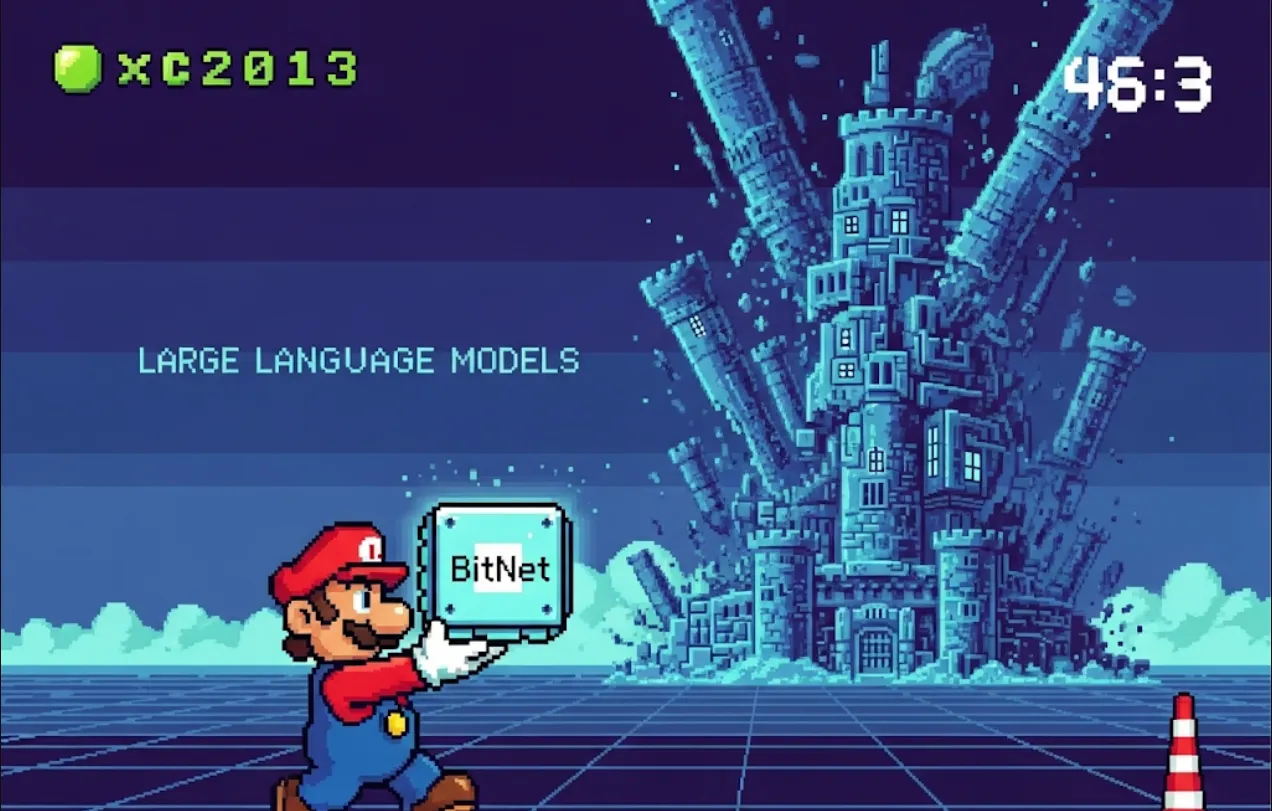
BitNet is an inference framework for 1-bit LLMs. What does "1-bit" mean? In traditional LLMs, the weights are stored using 16 or 32-bit floating-point numbers. BitNet, on the other hand, quantizes these weights to just a single bit (either +1 or -1). This is a radical change that leads to massive reductions in model size and computational requirements.
Think of it like this
a regular LLM is a high-resolution, full-color photo . A BitNet model is more like a black-and-white sketch . While you might lose some detail, the sketch is much, much easier to store and transmit, and you can still recognize the subject.
The official microsoft/BitNet repository is the reference implementation that shows how to perform inference on these ultra-low-bit models efficiently.
From a software engineer's viewpoint, BitNet provides solutions to some of the biggest challenges with deploying LLMs
Massive Reduction in Memory and Storage
The most obvious benefit is the small size. A 1-bit model is theoretically 32 times smaller than a 32-bit model of the same architecture. This means you can run huge models on devices with limited RAM, like mobile phones, IoT devices, or even edge computing hardware. It also drastically reduces the cost of storing and transmitting models.
Faster Inference
Because the weights are so small, BitNet can perform matrix multiplications much faster. Instead of complex floating-point operations, it can use simple bitwise operations (like XOR and POPCNT), which are highly optimized on modern CPUs and GPUs. This leads to significantly lower latency when generating responses.
Energy Efficiency
Reduced computation means less power consumption. This is a big deal for both data centers (saving on electricity and cooling costs) and battery-powered devices.
Reduced Development and Deployment Complexity
Since the models are so small, they're easier to manage, version, and deploy. You can even bundle them directly into applications without needing to download massive files at runtime.
In short, BitNet makes powerful LLMs accessible in environments where they were previously impossible to use.
The official repository provides the core components you need to get up and running. Here's a typical workflow and an example of how you might use the library.
First, you'll need to clone the repository and install the dependencies. The project is primarily based on PyTorch, so make sure you have that set up.
git clone https://github.com/microsoft/BitNet.git
cd BitNet
pip install -r requirements.txt
You might also need to install the custom CUDA kernels for the fastest performance. The repository has instructions for this.
The core of the framework is in how it handles the model's architecture and weights. You'll typically use a pre-trained 1-bit model available on Hugging Face or another model hub.
Here's a simplified example of how you might load a model and perform inference, similar to how you'd use a standard Hugging Face transformers model.
import torch
from transformers import AutoModelForCausalLM, AutoTokenizer

# Make sure you have the BitNet library and its dependencies installed.
# We'll assume a 1-bit model is available on Hugging Face Hub.
model_id = "path/to/your/bitnet-model"
# This might be a custom-trained model or one from a public repository.

# Load the tokenizer and the 1-bit model
# The AutoModelForCausalLM will handle the specific BitNet architecture
# if the model is correctly configured.
tokenizer = AutoTokenizer.from_pretrained(model_id)
model = AutoModelForCausalLM.from_pretrained(model_id, torch_dtype=torch.bfloat16)

# Prepare your input text
prompt = "The capital of France is"
input_ids = tokenizer(prompt, return_tensors="pt").input_ids

# Generate a response
# The generation process is the same as with a standard LLM
output_ids = model.generate(input_ids, max_length=50, do_sample=False)

# Decode and print the output
generated_text = tokenizer.decode(output_ids[0], skip_special_tokens=True)

print(generated_text)
# Expected output: "The capital of France is Paris."
For advanced use cases, you can dive into the source code to see how the bitwise operations are implemented. You can also fine-tune 1-bit models using techniques like LoRA (Low-Rank Adaptation), which is a common practice for adapting models without needing to train the entire network.
The BitNet repository provides the foundational building blocks for these tasks.