Leveraging PyTorch and Diffusers: State-of-the-Art Generative AI for Engineers
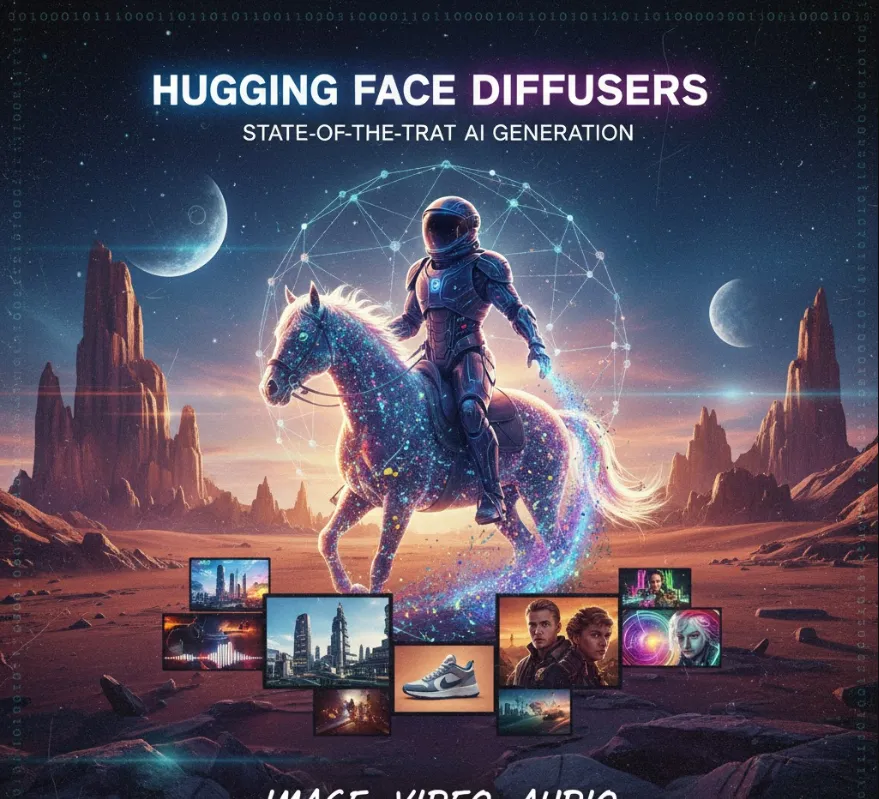
Here's a friendly breakdown of how it can be useful, how to get started, and a little sample code to get your hands dirty.
The huggingface/diffusers library is a game-changer for implementing generative AI features. Think of it as a well-structured, easy-to-use API that abstracts away much of the complexity of deep learning models.
| Feature | Description | Engineering Value |
| Pre-trained Pipelines | Provides ready-to-use, optimized code for popular models like Stable Diffusion, allowing you to generate content with just a few lines of code. | Rapid Prototyping & Development: Quickly integrate advanced generative features into your application without needing deep ML expertise. |
| Modularity | The library separates key components: models (like the UNet), schedulers (how noise is handled), and pipelines (the end-to-end process). | Flexibility & Customization: Easily swap out components (e.g., use a faster scheduler) or build custom pipelines to fine-tune performance and output. |
| Optimization | Built-in optimizations for memory and speed, including techniques for reduced precision (like float16) and model offloading. | Production Readiness: Efficiently run large, compute-intensive models on consumer hardware or in cost-sensitive cloud environments. |
| Model Hub Integration | Seamless access to thousands of pre-trained diffusion models and checkpoints on the Hugging Face Hub. | Massive Resource Pool: Use the latest SOTA models instantly, leveraging the community's work. |
| Training Utilities | Provides clean, documented scripts and tools for fine-tuning or training your own diffusion models. | Extensibility: Adapt models for your specific domain (e.g., medical imaging, architectural design) by easily fine-tuning them on custom data. |
In short, it lets you focus on the application logic rather than the low-level deep learning mechanics.
The library is built on PyTorch, and it's highly recommended to use a Python virtual environment. You'll also need the Hugging Face Transformers and Accelerate libraries for many of the advanced pipelines.
Create and activate a virtual environment (e.g., using venv or conda).
Install PyTorch (ensure you install the version with CUDA support if you plan to use a GPU).
Install the Diffusers, Transformers, and Accelerate libraries
# Install PyTorch, Diffusers, Accelerate, and Transformers
pip install torch diffusers transformers accelerate
For the latest features, you might sometimes install the library directly from the source repository
pip install git+https://github.com/huggingface/diffusers
The most common use case is text-to-image generation using a model like Stable Diffusion. The DiffusionPipeline class makes this incredibly simple.
This example uses the StableDiffusionPipeline, which is perfect for generating a high-quality image from a text prompt.
import torch
from diffusers import StableDiffusionPipeline
# The 'accelerate' and 'transformers' libraries are used under the hood!

# 1. Define the model to use and the device (GPU is highly recommended!)
model_id = "runwayml/stable-diffusion-v1-5" # A popular model checkpoint
device = "cuda" if torch.cuda.is_available() else "cpu"

# 2. Load the pipeline
# Use torch_dtype=torch.float16 and variant="fp16" for faster inference
# and reduced memory usage on modern GPUs.
pipe = StableDiffusionPipeline.from_pretrained(
    model_id,
    torch_dtype=torch.float16,
    variant="fp16"
)
pipe.to(device)

# 3. Define the prompt
prompt = "A majestic space shuttle launching from a futuristic neon city, cinematic lighting, 8k, detailed"

# 4. Generate the image
# We use a negative prompt to avoid unwanted features (like blurry or low-quality images)
image = pipe(
    prompt,
    negative_prompt="blurry, low quality, deformed, worst quality",
    num_inference_steps=25, # Number of steps for the denoising process
    guidance_scale=7.5 # Controls how much the prompt influences the generation
).images[0]

# 5. Save the generated image
image.save("space_shuttle_launch.png")

print("Image generated and saved as space_shuttle_launch.png!")
StableDiffusionPipeline.from_pretrained(...)
This is the core of the library. It automatically downloads and sets up all the necessary components—the Text Encoder, UNet, VAE, and Scheduler—from the Hugging Face Hub.
.to(device)
Moves the entire pipeline to the GPU (or CPU) for execution.
pipe(...)
Calling the pipeline object executes the end-to-end diffusion process
Turns your text prompt into embeddings (via the Text Encoder).
Starts with random noise (the "latent" image).
Iteratively denoises the image over num_inference_steps (guided by the UNet and Scheduler).
The final latent image is decoded into a visible image (via the VAE).