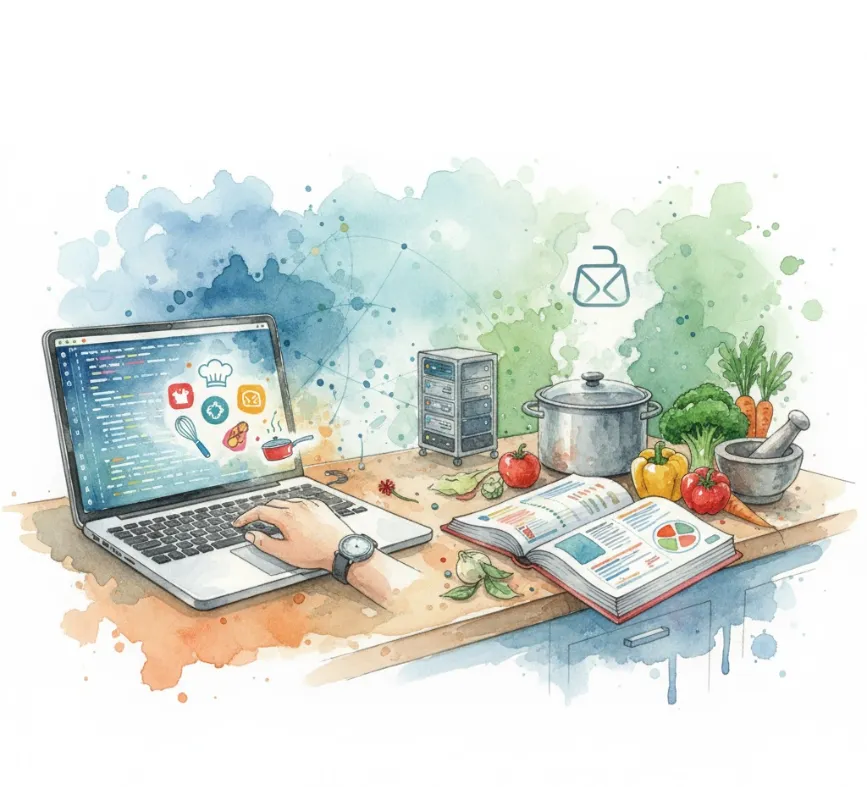
The Programmer's Cookbook: Applying Software Engineering Principles to Cooking
Here is a friendly, detailed explanation of how it can be helpful, along with some thoughts on "adoption" from a developer's viewpoint.
This guide is incredibly valuable because it reframes the complex, often messy, art of cooking into a more structured, logical, and reproducible process, which is exactly how developers like to work.
The Problem
Traditional recipes can be vague ("a pinch of salt," "cook until done").
The Developer Solution
The guide treats a recipe as technical documentation. Ingredients are variables with explicit types and quantities. Steps are a sequential workflow or function calls.
Benefit
It promotes precision and reproducibility. If your "code" (recipe) works well once, it should work well every time, reducing the variability that leads to cooking failures.
The Problem
You cook a dish and it's okay, but not great. How do you improve it?
The Developer Solution
Apply iterative development and refactoring.
Initial Commit (First Cook)
Follow the recipe precisely.
Issue/Bug Report
Note what went wrong ("Too salty," "Chicken was dry").
Refactor/New Branch
Create a slightly modified version of the recipe (e.g., reduce salt variable, lower oven temperature).
Pull Request (Sharing)
Once you've perfected your version, you can "commit" the changes to your personal recipe repository.
Benefit
This approach turns cooking from a guessing game into a continuous improvement project.
The Problem
Cooking a full meal involves juggling multiple complex tasks (main dish, side dish, sauce).
The Developer Solution
Think in terms of modules, classes, or functions.
Functions
A well-documented method like chop_onion(n_pieces) or make_rice(rice_type, water_ratio).
Classes
A dish can be a "class" that inherits properties from a parent (e.g., Class SichuanTofu extends Class BasicTofu).
Benefit
You build a personal library of reliable cooking methods. Once you master a fundamental technique (like searing meat), you can reuse that "function" across many different dishes without re-learning it.
Since this is a philosophy as much as a codebase, "adoption" is about changing your mindset.
Action
Go to the Anduin2017/HowToCook repository. Even if you don't read Simplified Chinese, study the directory structure and file organization. This shows you how to structure your own cooking knowledge.
Your Personal Repo
Create your own GitHub repository (e.g., MyHomeCookbook).
Initial Commit
Add a README.md defining your personal cooking standards (e.g., all times are in minutes, all temperatures are in Celsius).
Instead of writing a recipe on a messy piece of paper, write it in Markdown or a simple text file, organizing it like a structured script.
# Dish: Simple Tofu Stir-Fry

## Metadata
* **Prep Time:** 10 min
* **Cook Time:** 8 min
* **Yields:** 2 servings
* **Dependencies (Prerequisites):** * Have rice prepared (or call `make_rice()`)
    * Tofu must be pressed for 30 minutes.

## Ingredients (Variables)
| Variable | Type | Quantity | Unit | Notes |
| :--- | :--- | :--- | :--- | :--- |
| **tofu** | firm | 400 | g | Cubed (2cm $\times$ 2cm) |
| **soy_sauce** | light | 30 | ml | |
| **ginger** | fresh | 1 | tbsp | Minced |
| **oil** | vegetable | 15 | ml | For searing |

## Method (Functions)

1.  **Function `searing()`:**
    * Set **heat** to `HIGH`.
    * Heat **oil** in wok until shimmering (approx. 60 seconds).
    * Add **tofu** and sear for **3 minutes** per side. Goal: golden brown crust.
2.  **Function `sauce_mix()`:**
    * In a small bowl, whisk **soy_sauce** and **ginger**.
3.  **Function `final_assembly()`:**
    * Reduce **heat** to `MEDIUM`.
    * Pour **sauce_mix** over tofu. Stir gently for **2 minutes** until sauce thickens slightly.
    * Serve immediately.

## Testing/Debugging Log
* **Run #1 (2025-09-01):** Tofu broke apart. *Fix: Tofu was not firm enough. Need to press longer next time.*
* **Run #2 (2025-09-15):** Perfect sear, but slightly bland. *Refactor: Increase soy\_sauce variable to 35ml.*
The original repository has already inspired some excellent spin-offs that use AI, which is a perfect fit for a developer's skill set
Build a Meal Planner Script
Write a small script (Python, Node.js, etc.) that randomly selects a recipe from your MyHomeCookbook based on specific criteria (e.g., cook_time < 30 min, main_ingredient == 'chicken').
Automated Shopping List
Write a parser that reads the Ingredients section of your chosen recipes and automatically compiles a shopping list and checks it against a local "Pantry Inventory" file.
Use AI for Recipe Generation
Tools based on this concept (like the ones mentioned in the original repo's derivatives) use AI to act as a personal coding assistant for cooking, helping you design new meals or debug existing ones.